
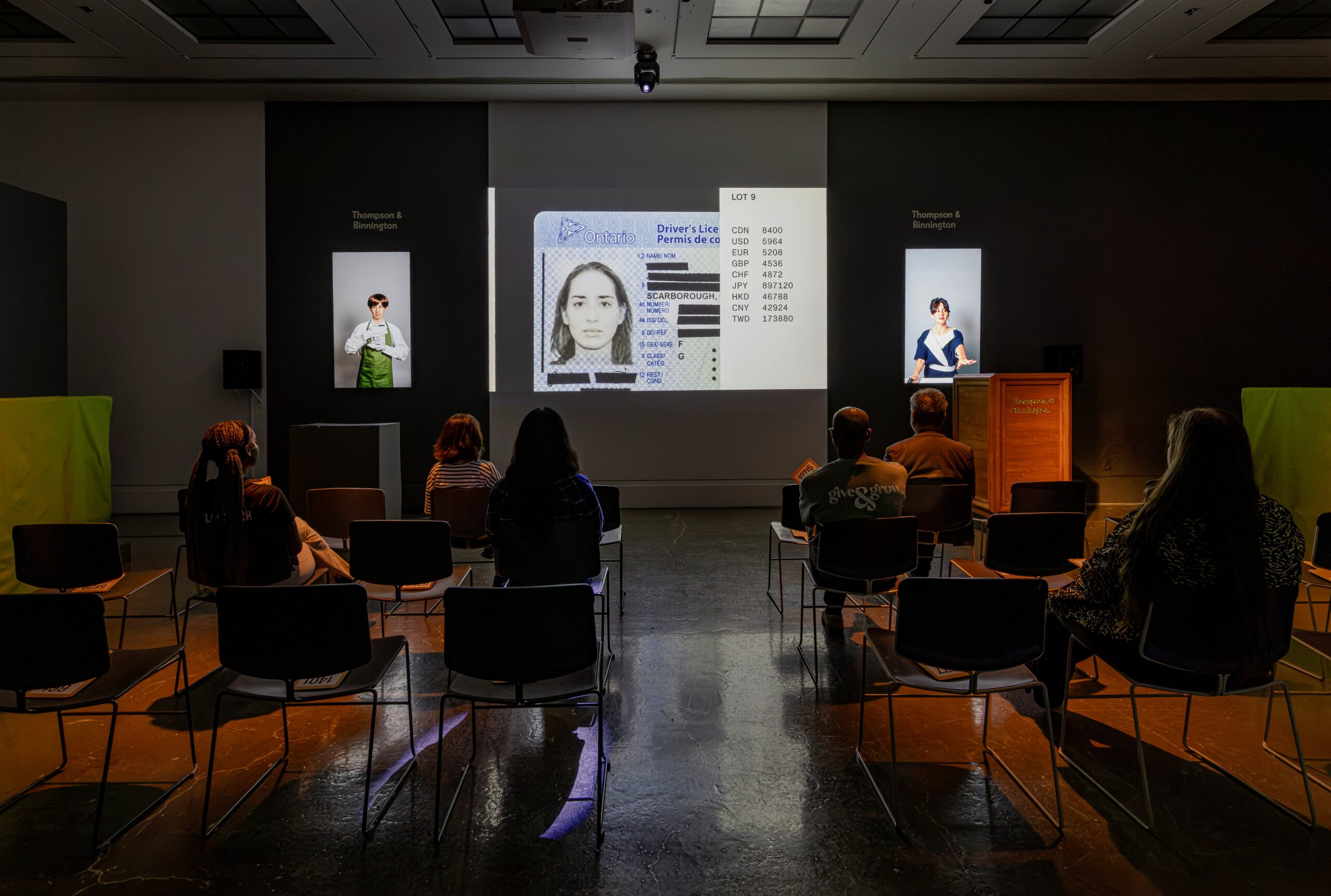
Electric Neon Clock
Artists: A.S.M. Kobayashi
Art Gallery of Mississauga (2026)
Electric Neon Clock is a hybrid, immersive work by A.S.M. Kobayashi that mixes documentary, performance, and installation. Born and raised in Mississauga, and based in Toronto and New York City, Kobayashi is known for her performative projects that take deep dives into found archival material. For this exhibition, the artist turns to her own family archives, which are part of Canada’s history of forcibly incarcerating and dispossessing thousands of Canadians of Japanese heritage.
This project began when Kobayashi first encountered the Canadian government’s WWII custodial file on her great-grandfather and subsequently discovered case files belonging to other relatives, their friends, and a wider community of displaced people of Japanese descent. These historical documents detail inventories of their homes and businesses, and include government correspondence, internal memos, and court transcripts. All adults named in the original documents have passed away, leaving their children, now seniors, as bearers of the only first-person accounts of this period. These living relatives were infants and young children at the time, making the custodial file the most enduring testimony of the artist’s family during those years.
Electric Neon Clock asks: How can the artist liberate forensic practices and state records to undermine their original intention and use them to reconstruct the community and families they were designed to dismantle? Relying on the custodial file as a guide, Kobayashi adapts this record into an installation and live performance detailing her family’s experience. Using video, sound, archival documents, a substantial photo archive, and the innovative format of a live auction, Kobayashi welcomes audiences to delve into her family’s file and join her in assessing the inventory’s value and humanizing its contents.
https://www.artgalleryofmississauga.com/events/a-s-m-kobayashi-electric-neon-clock/
I've Been Here Before
Artists: Cathie Jamieson and Jill Price
Art Gallery of Mississauga (2026)
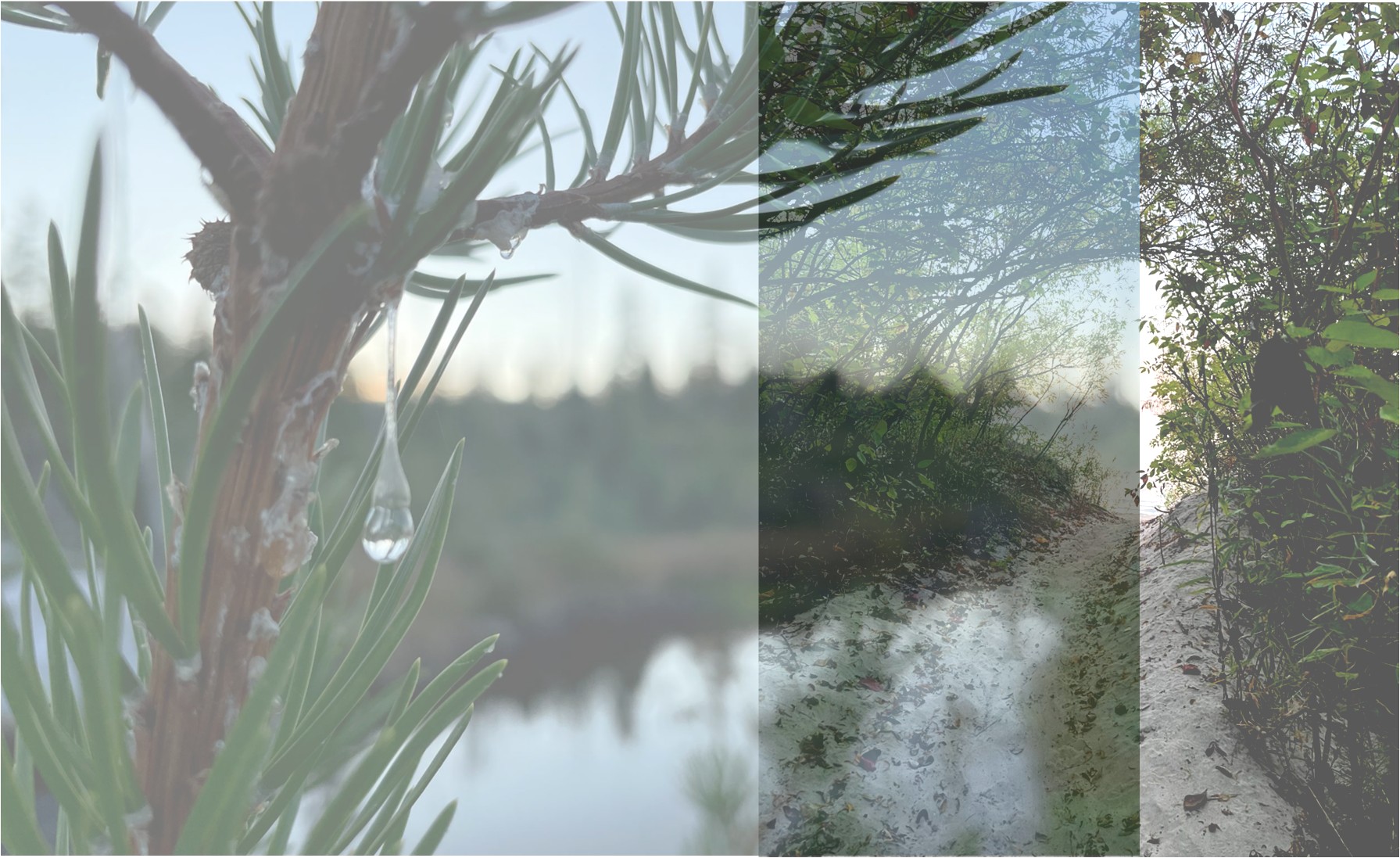
When art evolves through a sensitivity to materials and care for the environment, it can illuminate the implications of our day-to-day behaviours as consumers and urban dwellers. In I’ve Been Here Before, Mississaugas of the Credit First Nation artist Cathie Jamieson and Barrie-based artist Jill Price share their land-based practices, which are both grounded in mindfulness and a commitment to opening up conversations around our collective responsibility to protect the earth.
Jamieson’s work is informed by ancestral Indigenous knowledge of harvesting materials in accordance with natural laws. Through a series of installations using supplies carefully gathered on her Manitoulin Island forest property, such as tree bark and branches, plants, and florals, she brings elements and gestures connected to her teaching practice and healing workshops into the gallery. By centring the medicinal properties and symbolic meanings of these materials, she offers a space for learning and reconnection.
Price’s work considers methods of unmaking systems of harm rooted in colonialism and global industrial capitalism. Her sculptural installations derive from discarded materials she has collected along Ontario shorelines, which are then cleaned, reused, recycled, and repurposed. Informed by a childhood spent along the shores of Lake Ontario and by a sense of ecological urgency, her work reflects the understanding that, in the artist’s words, “environmental harm is not abstract but deeply intimate and shaped by daily consumption and discard.”
Jamieson and Price share important areas of connection in their distinct practices, both of which
invite viewers to reflect on ways of generating acts of care and repair toward the land. Ultimately, I’ve Been Here Before evolves from an understanding that the living systems that sustain and surround us are not passive resources, but active relations whose well-being is deeply entwined with our own.
https://www.artgalleryofmississauga.com/events/ive-been-here-before-cathie-jamieson-and-jill-price/
A Petal for a Petal, A Deed for a Deed—The Garden We Could Have Been
Artists: Shaheer Zazai
Art Gallery of Mississauga (2026)
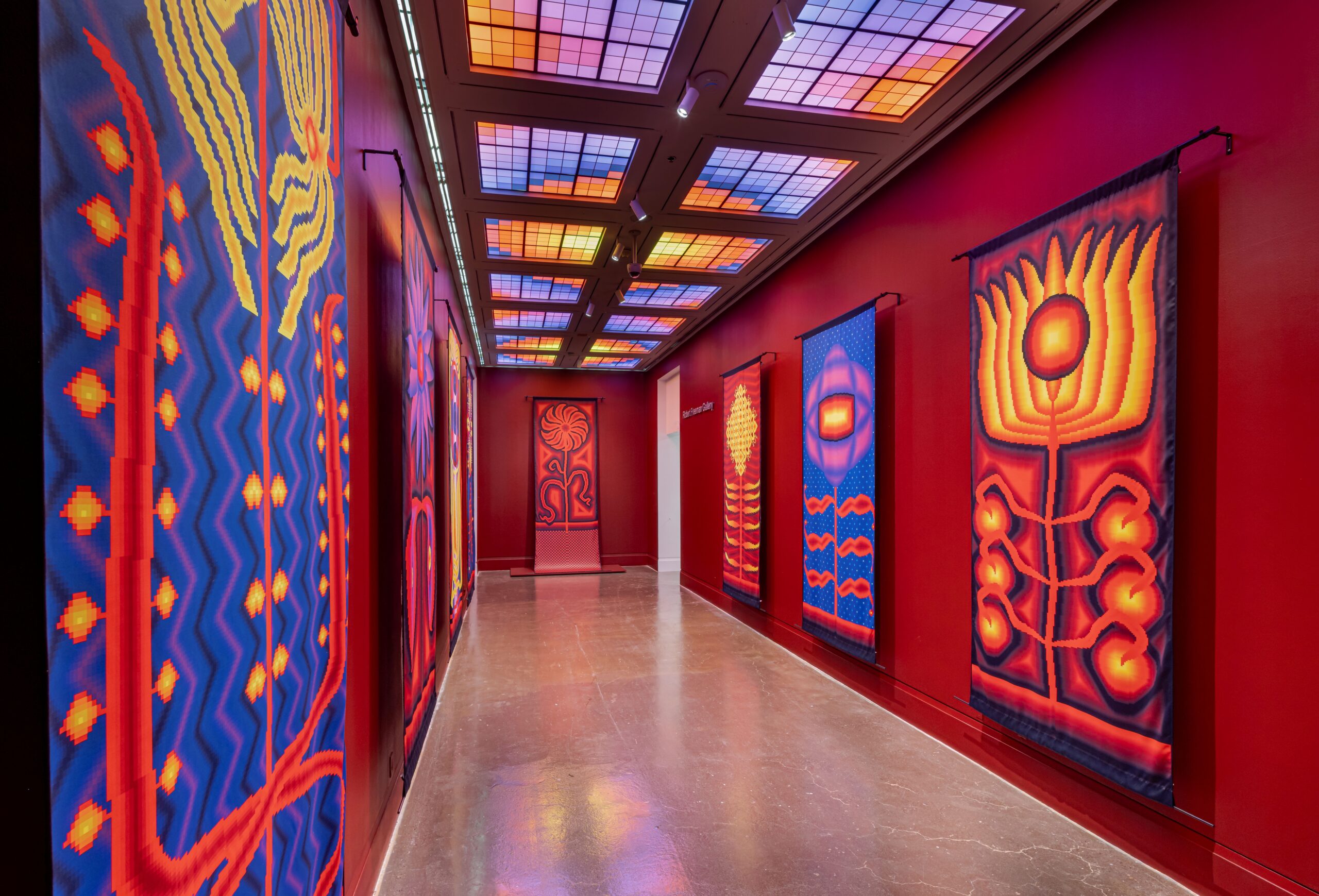
Shaheer Zazai’s installation, A Petal for a Petal, A Deed for a Deed—The Garden We Could Have Been, envisions a world where creation and destruction coexist. Expanding his ongoing exploration of the intersection between digital language and textile traditions, Zazai draws from the history of floral motifs in Afghan carpets and reimagines them at a monumental scale, through towering fabric scrolls and an illuminated ceiling mosaic. These darkly radiant blooms are not ornamental, but act as silent witnesses, emerging from the remains of a world burned by human neglect. Here, a garden of paradise becomes a garden of consequence, as floral sentinels rise in judgement of the destruction humans create and the warnings left unheard.
https://www.artgalleryofmississauga.com/events/shaheer-zazai-%CE%B9-whyishnave-suthagar/

Ninaivu—What We Remember, What We Release
Artists: Whishnave Suthagar
Art Gallery of Mississauga (2026)
Whyishnave Suthagar’s project நினைவு | Ninaivu—What We Remember, What We Release turns toward intergenerational healing within the Eelam Tamil diaspora. At its centre glows a Kolam-inspired mandala, which draws upon traditional Tamil artistic motifs. Additionally, a series of Illuminated texts feature letters exchanged between first- and second-generation Tamil Canadian family members that recall memories of leaving Sri Lanka during its civil war and building a life in a new country. These works speak to the shared but differently experienced journey of diaspora: what is inherited, what is grieved, and what is cherished. At the heart of the space, visitors are invited to write letters of their own, becoming part of an intergenerational conversation that honours memory and fosters healing.
https://www.artgalleryofmississauga.com/events/shaheer-zazai-%CE%B9-whyishnave-suthagar/
The Search for the Black Madonna and Green Tara
Artists: Winsom Winsom and Tara Darrall
Art Gallery of Mississauga (2025)
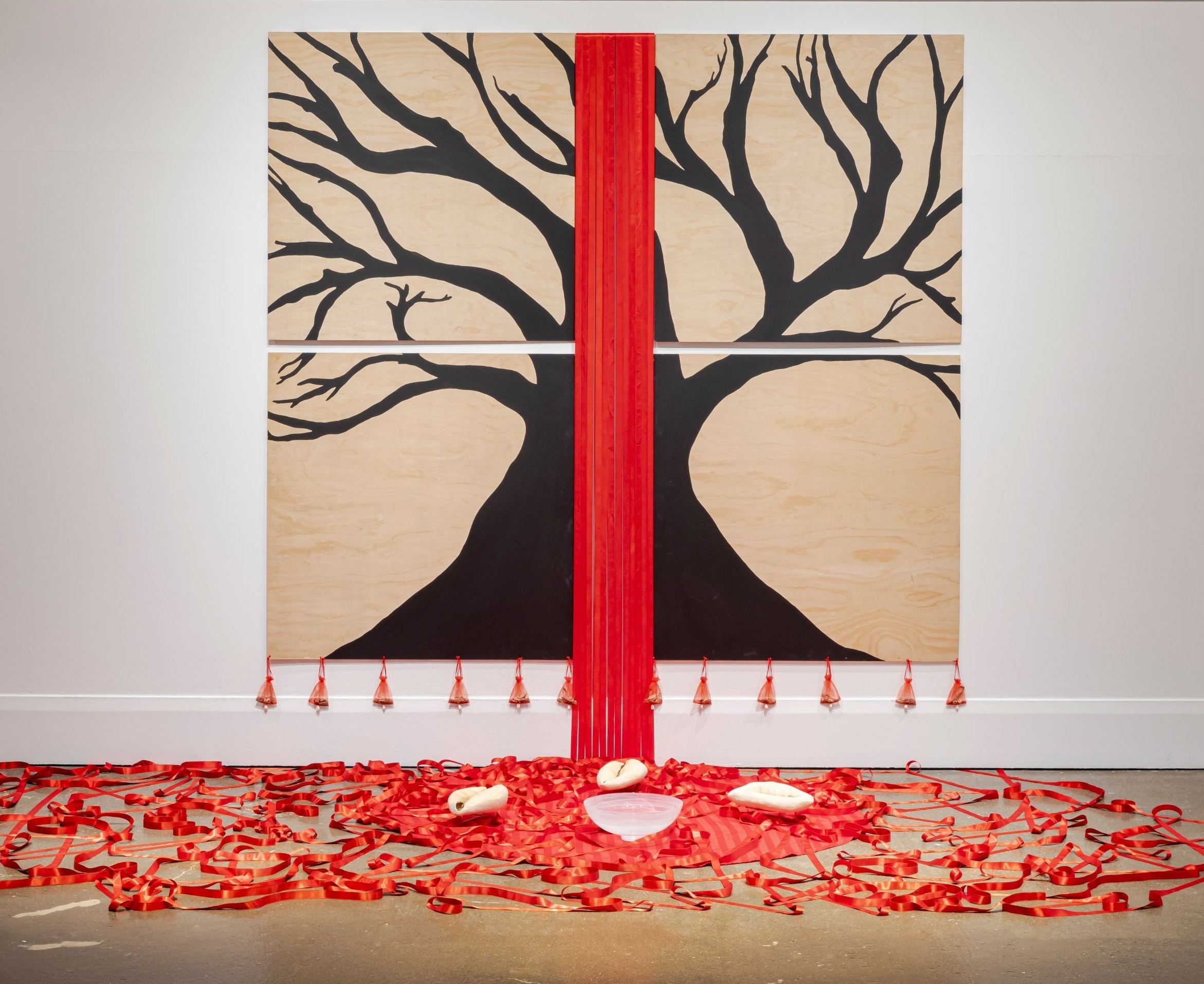
Over several decades, Winsom Winsom has expressed her own spiritual journey through her multimedia work and shared her knowledge as a mentor, teacher, and advocate for the arts. For this artist—who has travelled the world and now calls Mississauga her home—art and life are inextricably connected. Her work explores themes of freedom, survivance, resilience, and renewal within the context of the Black Atlantic experience. As a person of African, Maroon, Arawak, Spanish, and Scottish ancestries, Winsom draws from her mixed heritage to incorporate extensive symbolism and ritual references in her work, interpreting the elements, land, animal, and human presence within the context of Afro-centric value systems.
Featuring both existing and new bodies of work by this senior artist and self-described “child of the universe,” The Search for the Black Madonna and Green Tara traces the trajectory of Winsom’s emotional, physical, and spiritual journeys. The exhibition includes an expansive collaborative project with Winsom’s daughter, artist Tara Darrall. Together, they explore the layers of their mother-daughter relationship through a suite of paintings. Guided by aspects of the seven chakras—the energy centres within our bodies—these works are a personal meditation on the artists’ intertwined development of their identities.
https://www.artgalleryofmississauga.com/events/the-search-for-the-black-madonna-and-green-tara-winsom-winsom-and-tara-darrall/
Across Latitudes
Artists: Soheila Esfahani, Heidi McKenzie, and Zinnia Naqvi
Art Gallery of Mississauga (2024)
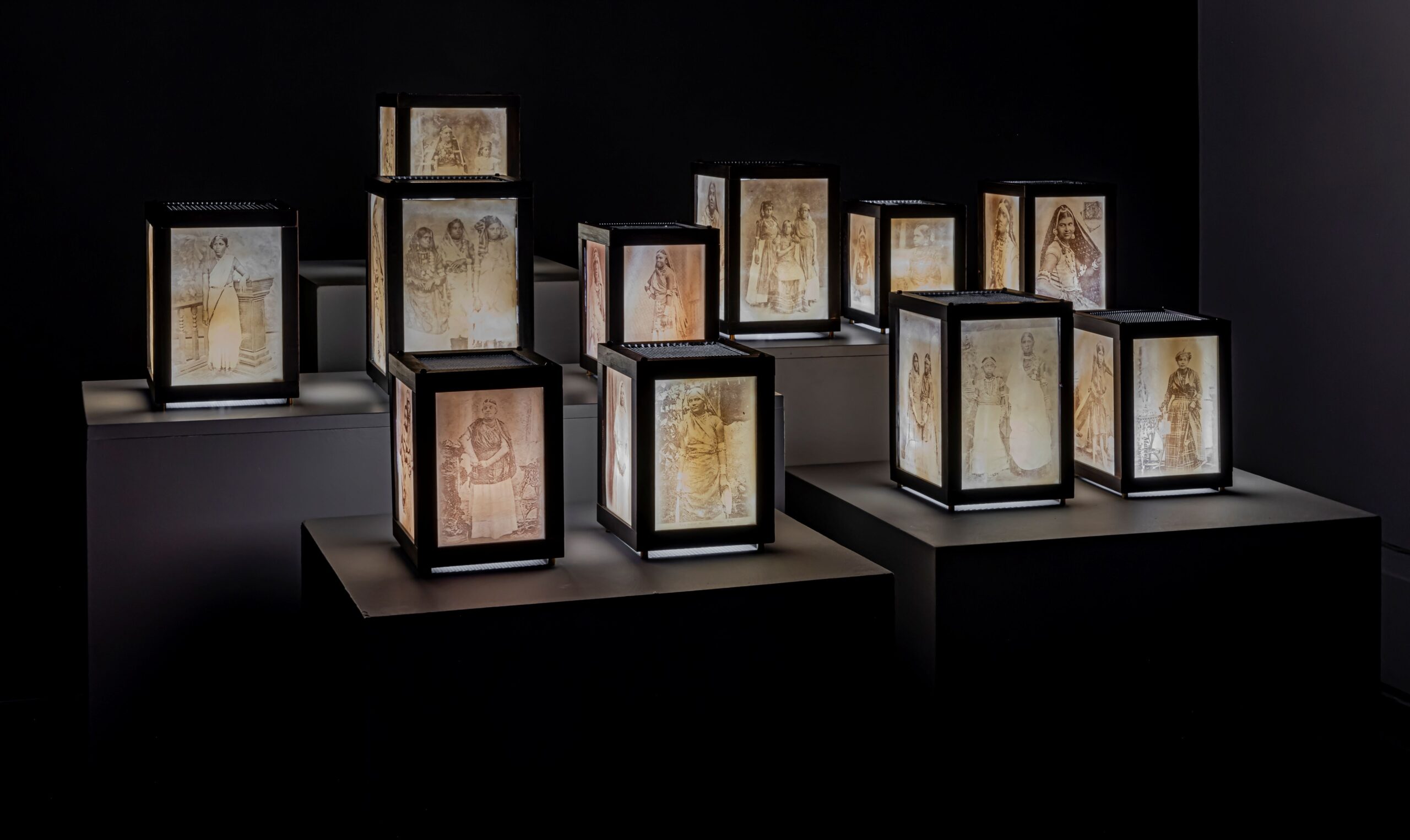
Across Latitudes examines the intricate realities of moving between cultures and across generations in the process of forging identities and locating our place in the world. The distinct art practices of Soheila Esfahani, Heidi McKenzie, and Zinnia Naqvi all draw from experiences of diaspora to explore the complex terrain of cultural migration and commodification.
This exhibition highlights the artifice of sites and objects that are intended to represent national identity—images in postcards, gift shop trinkets—and how they simplify and misrepresent the realities of lived experience. The works shown here consider the uncomfortable impact of such commodities on the process of shaping personal identity and aim to unravel the stereotypes they perpetuate. By holding these objects up for examination, and by integrating a diverse range of culturally significant markers of personal identity, such as traditional motifs, family and archival photographs, and mementos from childhood, these three artists engage in creative acts of revisiting, reworking, and reclaiming to offer new interpretations and meanings.
The artists in this exhibition inscribe, in different ways, their experiences of belonging amid the construct of what it means to be Canadian. Turning to their uniquely individual paths of migration—with diasporic roots in Iran, the Caribbean, and Pakistan—their works counter the limitations of myth-making and foreground the multi-dimensionality of intercultural experience.
https://www.artgalleryofmississauga.com/soheila-esfahani-heidi-mckenzie-and-zinnia-naqvi-across-latitudes/

Between Us
Artists: Jorian Charlton
Art Gallery of Mississauga (2023)
Straddling the worlds of fashion photography and intimate portraiture, Jorian Charlton’s work emphasizes the beauty and style of her subjects while exploring contemporary modes of Black representation. Between Us brings together images produced in-studio and outdoors to focus on the Mississauga-based artist’s intuitive and collaborative approach toward portraiture and the intimate relationship between photographer and subject.
Charlton’s models are a combination of friends, family, and people she connects with through Instagram. Already aware of how her subjects opt to present themselves on social media, Charlton is interested in working with her subjects to explore alternative avenues of self-expression. While she remains inspired by digital representation, she chooses to work in film, using a medium-format camera. This analogue process is intentionally slower, more technical, and less immediate.
“In my photography, I’m trying to create a visual style that is uniquely my own,” Charlton says. “Regardless of the shoot, I aim to capture my subjects in a timeless way that gives the model a sense of strength and evokes intrigue or connection with the viewer.”
https://www.artgalleryofmississauga.com/events/jorian-charlton-between-us/

Sara Angelucci: Undergrowth
Touring exhibition: SPAO, Ottawa (2021); Art Gallery of Sudbury (2021-2022); Varley Art Gallery of Markahm (2023); Tom Thomson Art Gallery (2023); Art Gallery of Mississauga (2024
Sara Angelucci transforms found photographs and creates images exposing the cultural and historical conditions outside the image frame, bringing attention to the social forces that generate the language of photography.
Undergrowth brings together several bodies of work produced over the last decade that examine the ways in which photographic practices have contributed to the divide between humans and nature. This direction finds its impetus in her series Aviary (2013), which morphs images of extinct or endangered birds with found Victorian cartes-de-visite portraits to form strange, hybrid creatures. These works, alongside series such as Arboretum (2016) and the sculptural installationSightings (Ivory-Billed Woodpecker) (2015), consider the implications of the historical Western impulse to capture and classify nature.
Angelucci’s most recent works are grounded in environmental engagement, investigating local plant species and the vulnerable habitats we disturb. Nocturnal Botanical Ontario (2019–ongoing) highlights the intricate webs of native, introduced, and invasive plant species in our immediate proximity, while her video Ghost Orchard (2022) captures the overrun growth of an abandoned orchard just before impending plans for urban redevelopment will cause its disappearance.
Throughout these interconnected projects, Angelucci offers thoughtful and intimate acts of attention that evolve from a place of reverence and respect, as she seeks to examine and reconcile our relationship with the natural world.
Publication: https://ecwpress.com/products/sara-angelucci-undergrowth-broussailles?_pos=1&_sid=94a7738d5&_ss=r

Grounded
Artists: Kim Adams, Lise Beaudry, Greg Curnoe, Steve Driscoll, Suzy Lake, Nicholas Pye, Soko Negash and T&T
Oakville Trafalgar Memorial Hospital (2020 - 2023)
An exhibition at the Oakville Trafalgar Memorial Hospital, titled "Grounded," considers the complex relationship between people and nature, and the importance of maintaining this connection. It resonates in photographs by Suzy Lake and Nicholas Pye, as well as in Steve Driscoll’s paintings, in terms of the need to slow down and take time to reconnect with nature. Lise Beaudry’s photo-based work derives from the landscape of her childhood—a touchstone for remembering the past, while Soko Negash reconnects to the healing methods used by her family and local community through still lifes of various traditional remedies gathered from nature. Through prints and sculpture, T&T and Kim Adams imagine future innovations for ecologically-minded lifestyles, while Greg Curnoe’s work celebrates an environmentally-friendly mode of transportation. Conscious of the realities of ever-increasing urbanization and climate change, Grounded suggests that our sense of self and well-being are intricately tied to the natural environment.

Close to Home
Artists: Tonia Di Risio, Soheila Esfahani, Rafael Goldchain, Xiong Gu, Sanaz Mazinani, Sumaira Tazeen, Denyse Thomasos and Jeff Thomas
Oakville Trafalgar Memorial Hospital (2019-2020)
Close to Home brings together artists from a range of cultural backgrounds, with works that speak to each artist’s connection their country of origin and to ideas surrounding home,migration, and what it means to belong. These familial connections come from near and far, such as Iranian-Canadian artist Soheila Esfahani’s focus on the translation and movement of cultural influences;Canada-based Pakistani artist Sumaira Tazeen’s research into the stories of recent immigrants; and Iroquois artist Jeff Thomas’s photographic investigations into Canada’s appropriation of Indigenous lands.Through these artworks, Close to Home highlights the unique and diverse cultural experiences that inform Canadian identity.

Wanderings
Artists: Kim Adams, John Armstrong, Panya Clark Espinal, Steve Driscoll, Neeta Madahar, P. Mansaram, Andrew McPhail, Monica Tap and David Urban
Oakville Trafalgar Memorial Hospital (2018-2019)
Wanderings is a year-long display of contemporary artworks placed along the main public corridors of the Oakville Trafalgar Memorial Hospital. It focuses on art that meanders along places and ideas: an open suitcase that leads to unknown destinations; paintings that capture the sensation of being immersed in the wilderness or a hectic urban streetscape; a photograph that captures migratory birds in temporary flight; artworks that contemplate the changing seasons, or reflect on past events. Each piece is intended to open a space of contemplation and exploration for the visitors, patients and staff who travel these hospital hallways.

Gros Morne Whirl, public art commission for Creative Gros Morne
Artists: Mary Ann Liu and Paul Slipper
Norris Point, Gros Morne, Newfoundland
Curator for Creative Gros Morne in Newfoundland, to oversee the commission of a piece of permanent, site-specific outdoor public art in the Gros Morne community. Paul Slipper and Mary Anne Liu's Gros Morne Whirl launched July 1, 2017 and is on display in the community of Norris Point from May to October annually.

Crafted
Artists: Kim Adams, Lizz Aston, Carmelo Arnoldin, Janet Morton, Monika Napier, Ed PIen, Breanna Shanahan, Jay Wilson, Xiaojing Yan
Oakville Trafalgar Memorial Hospital (2016-2017)
Crafted brings together contemporary artworks that draw from traditional crafting methods with unconventional results. Whether weaving with pop cans, or piecing together words from hundreds of toothpicks, these artworks encompass a wide range of materials and techniques in order to emphasize the value of repetitive and labour-intensive practices. This kind of intricate hand-work has a long history of providing comfort in many forms, and these unexpected and highly individualized interpretations of the medium are intended to add vibrancy, energy, and intrigue to the hospital environment.

Visit our website: andersonwilsonprojects.org
Publication: visit our website: andersonwilsonprojects.org
Possible Worlds
Artists: Kim Adams, Sara Angelucci, Jeremy Borsos, Edward Burtynsky, Susan Dobson, Marie Heintzman, Scott McFarland, Janice Mason Steeves, Naoko Matsubara, Julia Mori, Janet Morton, Tazeen Qayyum, David Rokeby, Jennifer Walton, Xiaojing Yan
Oakville Trafalgar Memorial Hospital (2015-2016)
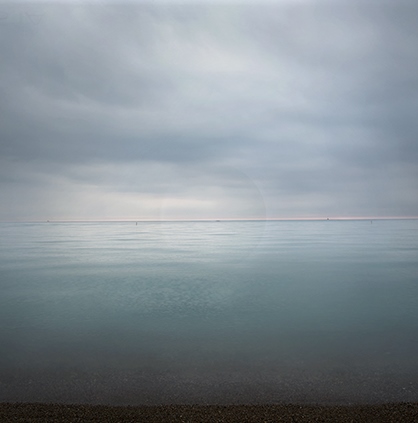
This exhibition, installed throughout the public spaces of the New Oakville Trafalgar Memorial Hospital, takes its thematic cue from the building's architectural emphasis, notably its sensitive integration of elements from nature. Possible Worlds likewise brings this environment indoors, through artworks that create an expansive experience of nature. These contemporary pieces by artists of local and national renown use a range of media, including printmaking, painting, photography, video and sculpture. The artists adopt varied viewpoints, from a birds’ eye perspective that allows viewers to witness the environment at a distance, to creating near-microscopic worlds that require intimate viewing, to expressing more abstract interpretations of the landscape. The passage of time is conveyed through artworks that merge the past and the present, or interpret duration in unexpected ways. Possible Worlds invites visitors to take a moment to contemplate, discuss, and learn more about how these artists perceive and reimagine the world around them.

Circling the Inverse Square
Artists: Adam David Brown, Jessica Eaton, Karilee Fuglem, Marla Haldy, Richard Sewell, Charles Stankievech
Kitchener-Waterloo Art Gallery, 2013–14
Circling the Inverse Square presents artworks that derive from a particularly speculative approach to making work, drawing connections to the intricate processes behind observation and enquiry in physics. The six artists brought together for this exhibition share a scientific state of mind in their systems- and process-based approaches, yet the works they create are not illustrative of scientific principles or theories. Instead, they circle the language, concepts and the aesthetics of physics toward more suggestive ends.
In these works, the boundaries between the individual and the universal are brought to the fore, as they lend form to connections that are usually invisible. The shape of sound, the connection between microscopic pores and star constellations, and our methods for processing the visual world are some of the areas under investigation. Paradoxes and conundrums are often at the root of these explorations, which are just as often humorous and playful as they may be serious and speculative. Here, the methods and edges of human perception are under examination, in ways that often embrace systematic approaches, yet result in sculptures, installations, photographs and drawings that are, ultimately, poetic.

(Da bao)(Takeout)
Artists: Sara Angelucci and Han Xu, John Armstrong and Paul Collins, Cathy Busby, Gang Chen, Brendan Fernandes, Nan Hao, Ming Hon, Knowles Eddy Knowles, Laiwan, Minjeong Oh, Ed Pien, Shen Yi Elsie, Laurens Tan, Xiaojing Yan, Zhang Zhaohui
Varley Art Gallery of Markham (2012) and circulated to the Art Gallery of Mississauga, PlugIn ICA in Winnipeg, and Surrey Art Gallery (2012–2014)
(Da bao)(Takeout) attempts to locate a type of pan-ocean dynamic between China and the West, specifically Canada, by focusing on artists who investigate, adapt and instill ideas from abroad into their practice, while appreciating the palpable slippages that occur in the transference of ideas from one ethnicity to another. An exhibition of international scope, (Da bao)(Takeout) brings together the work of 19 artists, largely from China and Canada. Two curators, living on either side of the globe, worked together to push beyond the traditional “exchange” format to create an exhibition that functions as a cohesive whole. It focuses on the artists’ shared experiences of being “taken out” of familiar contexts and encountering a strikingly different culture. Their individual experiences and the ways in which they discover areas of shared experience inform the work included in this exhibition. While their individual voices each occupy unique positions, collectively, they speak to issues of cultural transference, highlighting the gaps, distances and misunderstandings inherent in communication across cultural divides.

Hyper Spaces: José Manuel Ballester, An Te Liu and Lynne Marsh
Oakville Galleries at Centennial Square, 2011–2012
In response to the white-cube, uniquely cavernous space of the Centennial Square location of Oakville Galleries, this group exhibition explores urban architecture and public space through the lenses of tension and anxiety. With a quasi-science-fiction approach, these artists turn the familiar space of the metropolis into unsettling, parallel worlds where dislocation and estrangement takes centre stage.
José Manuel Ballester, An Te Liu, and Lynne Marsh each conjure unsettled spaces, micro-worlds on the cusp of transition. In all instances, they are triggered by public architecture, from the epic scale of a German sports stadium to a conference centre in China to the gallery itself. Each of these artists fabricate a view of reality where nothing is certain, suggesting the psychological impact of all public architecture, however muted the desired effect.

Viva Voce
Artists: Dorian FitzGerald, Alison S.M. Kobayashi, Richie Mehta, Johnson Ngo, Denyse Thomasos, Carolyn Tripp, Jessica Vallentin, Rhonda Weppler/Trevor Mahovsky, Andrew Wright, Robert Zingone
Blackwood Gallery (Mississauga), 2011
This exhibition marks the 40th anniversary of the Art & Art History Program (University of Toronto Mississauga and Sheridan). Given the occasion, the curatorial method focused on the complex relationships between students and professors, as the participating alumni were selected through recommendations from past and present faculty members.
The Latin phrase “viva voce,” meaning “with the living voice,” is playfully adopted here to highlight the celebratory nature of an anniversary, while making reference to the outspoken professors who responded to the curator’s invitation to participate in the process. It connects to the notion of sharing information by word of mouth, or through reputation. By relying on the experiences of the program’s professors (in keeping with the anniversary date, 40 past and present faculty were contacted for recommendations), the selection process became a collective effort. This exhibition brings the connection between student and teacher to the forefront, underscoring the ongoing support that occurs after graduation, in the transition from student to colleague.

Therese Bolliger: Four Echoes
Oakville Galleries in Gairloch Gardens, 2009–2010
Since the mid-90s, Therese Bolliger’s practice has focused on the gaps between image and language, between abstraction and representation, and between object and viewer. Four Echoes surveys her recent work, bringing together a selection of drawings and sculptures. Throughout the four rooms of the gallery at Gairloch, Bolliger’s work explored the essence of form, consistently evoking shapes that lie beyond the world of objects.
The word choice “echo” in the title of this exhibition is significant. An echo reaches out from its originating object into space. Untethered from its source, it occupies a tenuous state of existence. Bolliger’s practice is occupied with these fragile spaces: articulating memory’s place between past and present, translating mathematical and philosophical constructs into form, and exploring the outer reaches of the animate. In doing so, she continuously hovers on the line between abstraction and representation, creating objects from the figments of imagination.

Burrow: Janice Kerbel, Adriana Kuiper, Liz Magor and Samuel Roy-Bois
Oakville Galleries at Centennial Square (2007) and circulated to Saint Mary’s University Art Gallery, Nova Scotia; and Musée d’art de Joliette, Quebec (2007–2009)
Burrow focuses on the human desire for comfort and escape, and how it can breed isolation and paranoia in an impossible search for absolute safety. It investigates the need for shelter while alluding to its potential to become a barrier to the outside world. The works in this exhibition speak to a yearning for extreme personal boundaries; to become invisible in the hopes of achieving safety and security. More importantly, they suggest the vicious cycle of this process and the relative absurdity of believing that people are capable of self-sustainability, particularly within the conditions of contemporary civilization.
Adriana Kuiper, in her Snack Bar Shelter, built a recreational facility out of cinder blocks, based on a drawing from a brochure on fallout shelters. Absurd and disturbing, it suggests how the nuclear family might pass the long hours while the world is coming to an end. Samuel Roy-Bois’ Ghetto presents the viewer with a claustrophobically enclosed living space visible through a plexiglas window, raising questions about the minimum requirements for human shelter and the loss of privacy associated with homelessness. Two sculptures by Liz Magor (Burrow and Carton II), and her photographic Deep Woods Portfolio, blur the line between human and animal shelters in the forest. Floor-plan drawings by Janice Kerbel from the series Home Fittings generate a cryptic visual pattern from calculations arising from a fearful and obsessive inventory of living spaces.
This exhibition draws attention to a universal, timeless and complex human condition, pointing to individual attempts at refuge in the face of unknown threats. The mindset of Burrow represents a state of ongoing internal conflict at its most basic, human level.
Publication: Catalogue available through Oakville Galleries or ABC books